Why print expertise matters more in AI assisted software development
 Nidhi Agarwal
Blog article content
A printer asks for a simple change: let corporate customers personalise a product, approve the artwork and send the order straight into production. AI can help a development team build parts of that workflow faster. But before development begins, someone needs to understand what “approved” means, which artwork should reach production and what happens when an order changes.
Those details determine whether the solution saves work or creates more of it.
What makes this harder in print is that most of those details have never been written down. The dieline holds information the brief does not. The tolerance on a press sits with the person who runs it. A ten-year-old MIS behaves a certain way when an order is cancelled mid-run, and nobody now remembers deciding that it should.
AI is very good at turning a specification into working code. The difficulty in our industry is that the specification often does not exist yet in a form anyone can hand over.
At DesignNBuy, this is why we see such a strong opportunity in combining AI-assisted software development with our experience in customised print workflows and personalisation. We understand the printing business and the software behind it. AI gives us another way to put that knowledge to work for our customers.
Understanding the workflow shapes the software
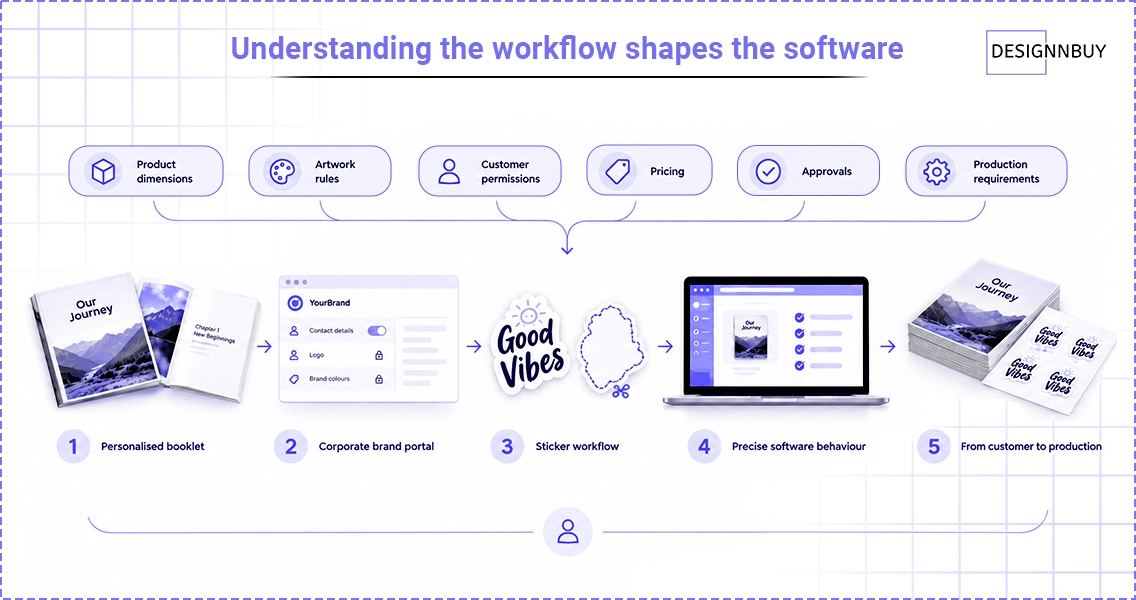 A personalisation journey continues well beyond the design editor. Product dimensions, artwork rules, customer permissions, pricing, approvals and production requirements all influence what the software needs to do.
Consider a personalised booklet. A change in page count may affect its cover dimensions, spine size and production files. In a corporate brand portal, a customer may be allowed to change contact details only while the logo and brand colours remain locked. A sticker workflow may need a cutting path that has a different purpose from the visible artwork.
These requirements have to be translated into precise software behaviour. They also need to be checked across the complete journey, from the customer’s choices to the files and information received by production.
Our experience helps us ask these questions early. That reduces the risk of developing a feature that looks right in a demonstration but needs substantial rework when it reaches a real business.
What this looks like on a real project
Stella Brands produces over a million custom K-Cup lids a day, with every order carrying its own artwork, lid specification and production routing. None of that was running through a system. Orders arrived by email, approvals sat in threads and the team tracked job status by hand.
Restructuring intake and approvals cut order errors by 40% and turnaround by 30%. But the part worth noting here is what happened after: our team visited the Las Vegas facility, watched the operation run, and came away with a list of requirements that had never appeared in any brief.
AI becomes more useful with the right context
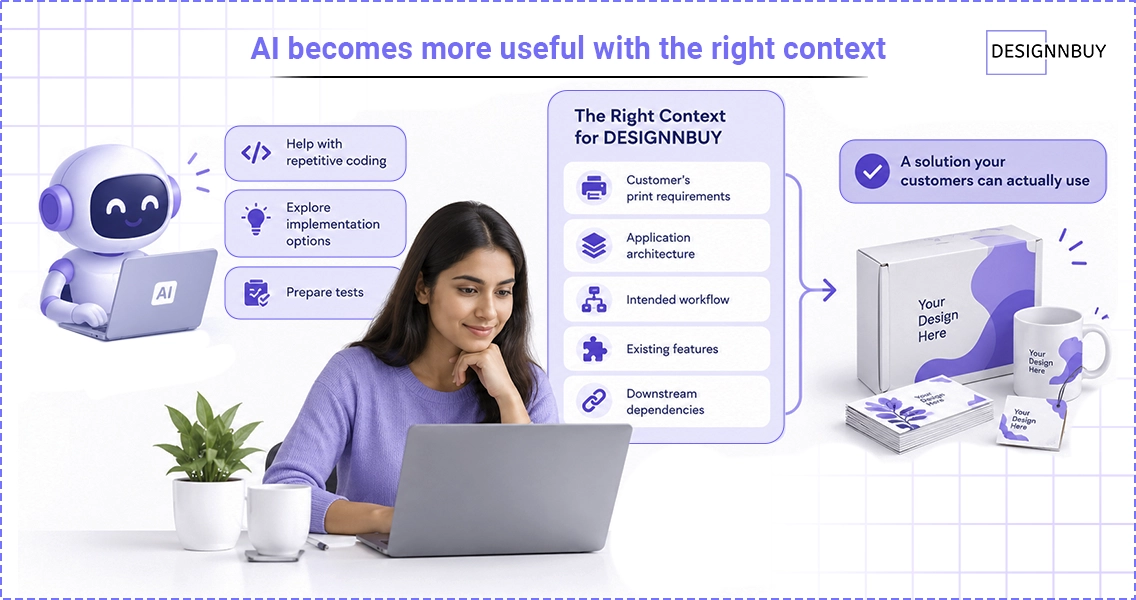 AI-assisted development can help with repetitive coding, exploring implementation options and preparing tests. Its usefulness depends on the context and judgement surrounding the task.
For DesignNBuy, that context includes both the customer’s print requirements and the architecture of the application being extended. We can bring knowledge of the intended workflow, existing features and downstream dependencies into development decisions.
This combination helps direct development effort towards a print solution the customer can actually use. It also allows quicker feedback on ideas before too much time is committed to the wrong approach.
The first release is the start of a longer responsibility
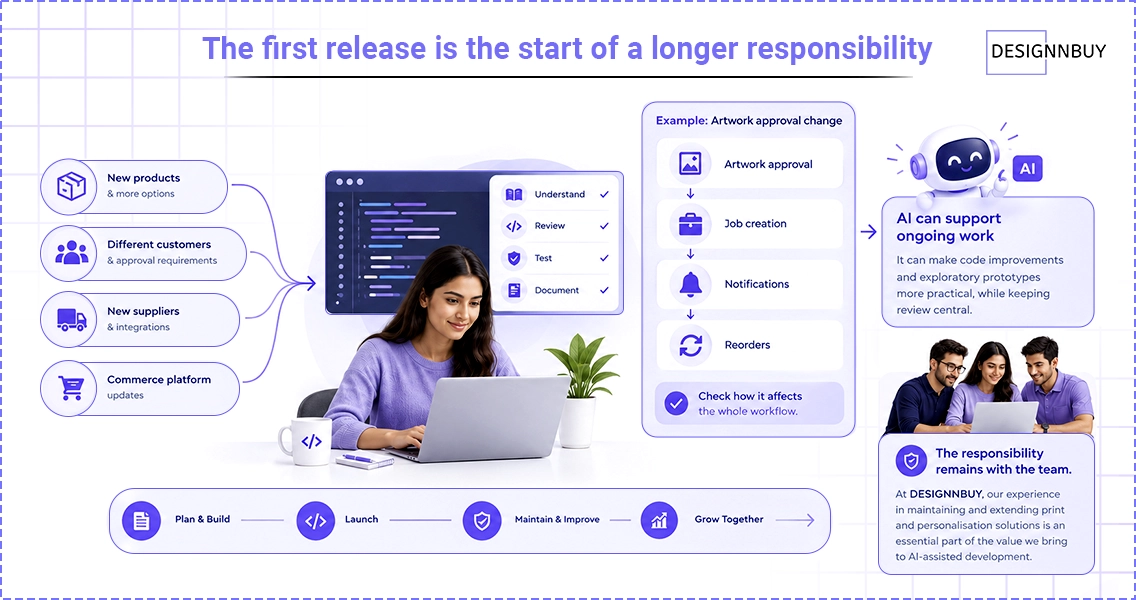 A print business keeps changing after a project goes live. It adds products, wins customers with different approval requirements, connects new suppliers and updates its commerce platform. The software needs to evolve alongside those changes.
That is why maintainability matters from the beginning. A team must understand how the application works, why particular decisions were made and which existing behaviours a new change might affect. Clear documentation, code review and meaningful regression testing help preserve that understanding.
For example, changing an artwork approval process should include checking how it affects job creation, notifications and reorders. A successful change needs to fit the whole workflow.
AI can support this ongoing work too.
Simon Willison describes how coding agents can make previously time-consuming code improvements and exploratory prototypes more practical, while keeping review central to accepting the result.
The responsibility remains with the team delivering the software.
At DesignNBuy, our experience in maintaining and extending print and personalisation solutions is an essential part of the value we bring to AI-assisted development.
Existing systems remain part of the picture
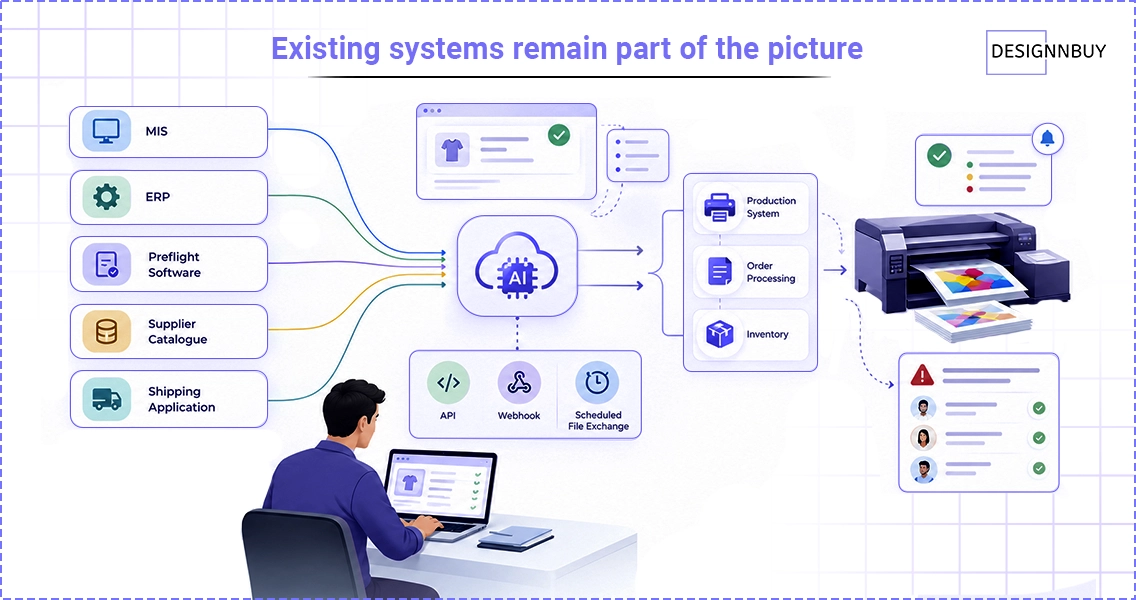 A printing business may depend on an established management information system, an ERP, preflight software, a supplier catalogue and a shipping application. These systems can be valuable even if they have no AI features.
They do not need to become AI-enabled before they can connect to software developed with AI assistance. What matters is how they exchange information and how reliably the combined workflow operates.
Depending on the application, that connection may use an API, a webhook or a scheduled file exchange. The engineering work includes understanding available interfaces, mapping data correctly and handling interruptions without losing orders or creating duplicates.
Imagine an approved order being sent to a production system that is temporarily unavailable. The solution needs a clear way to record the failure, retry safely and show the team what needs attention. Faster connector development is useful only when these operational details are addressed.
At DesignNBuy we understand the value of using generative AI to understand existing software and support gradual modernisation. For print businesses, that reinforces a practical opportunity: improve the workflow while building on systems that still serve the business well.
Measure the time saved across the whole project
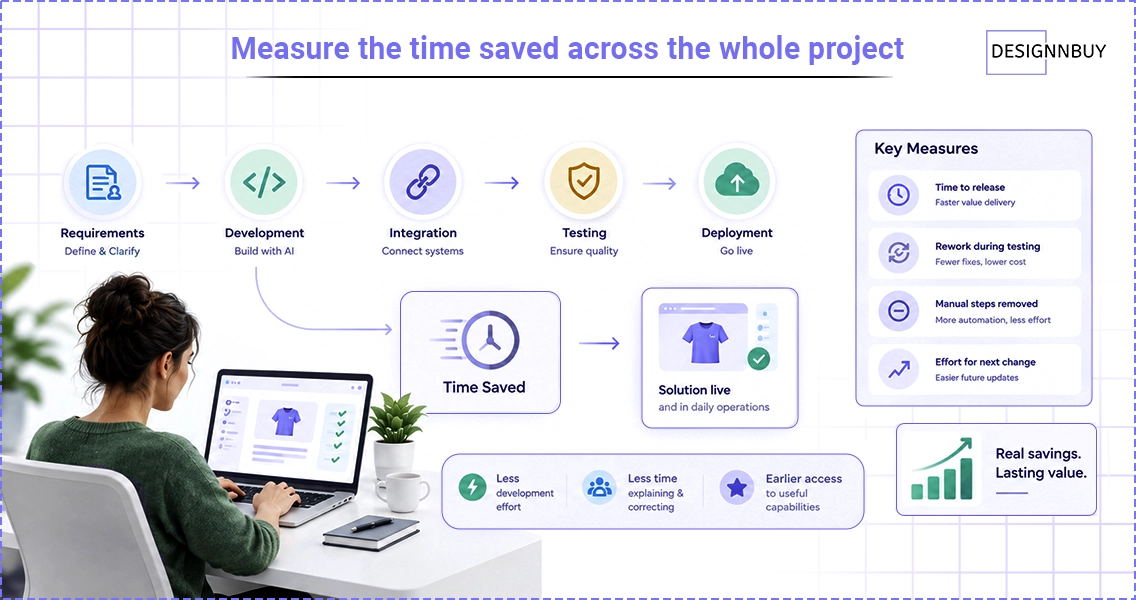 For a customer, turnaround time runs from defining a requirement to using the finished solution in daily operations. Coding is one part of that journey. Clarification, integration, testing and deployment also affect when the business starts receiving value.
This is where print expertise and AI-assisted development can work together. Understanding requirements earlier can reduce avoidable revisions. AI can help accelerate suitable development tasks. Experienced review can identify issues before they become costly production problems.
The potential benefit is less development effort, less time spent explaining and correcting requirements, and earlier access to a useful capability. That can make a previously postponed integration or workflow improvement more commercially practical.
The savings will vary by project. A familiar customisation and an integration with a poorly documented application will have different constraints. Credible expectations should reflect that difference.
We believe customers should assess the result through practical measures: time to an accepted release, rework during testing, manual steps removed and the effort required to make the next change. Those measures show whether faster development is producing lasting value.
Bring us a workflow, not a wishlist
The fastest way to test what is in this article is to walk us through one process you already know is costing you time: the approval loop, the reorder path, the handoff into production. We will show you how it would run.
Experience gives AI a clearer direction
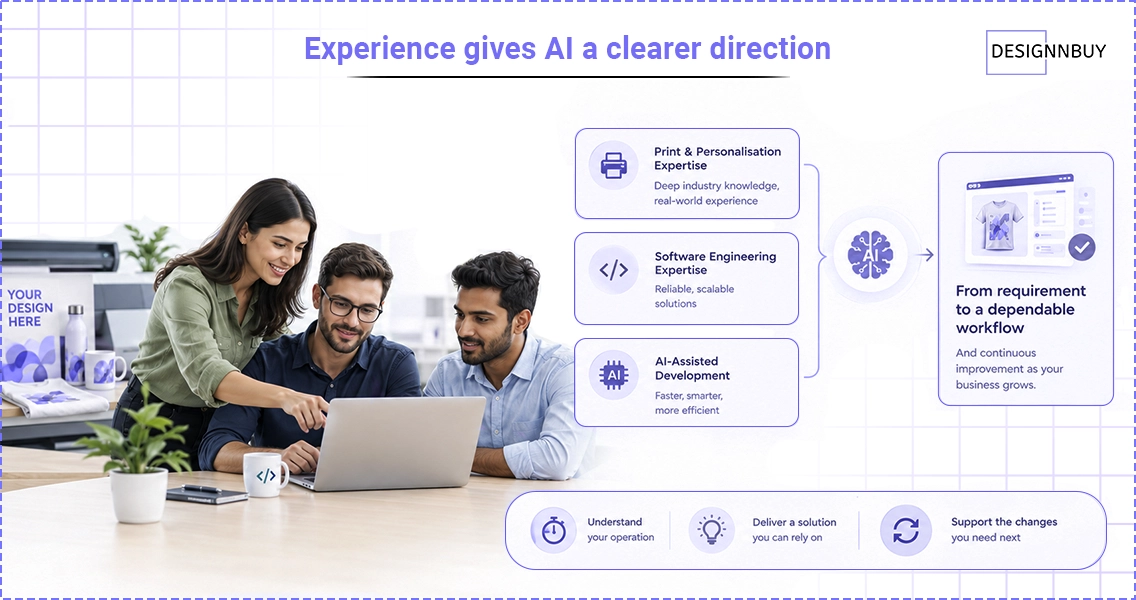 AI is opening new possibilities for how customised print software is built and improved. Taking advantage of those possibilities requires a clear understanding of the business the software serves.
At DesignNBuy, we bring together experience in print and personalisation, software engineering expertise and the use of AI-assisted development to help customers move forward faster. The aim is to turn a customer’s requirement into a dependable workflow, then keep improving it as the business grows.
For a printer considering its next investment, a useful question is: how quickly can this team understand our operation, deliver a solution we can rely on and support the changes we will need next?
That is the standard we believe should define AI-assisted development for the printing industry.
Start with the questions, not the code
Nidhi Agarwal
Co-founder/CEO, DesignNBuy
Nidhi Agarwal (Co-founder/CEO, DesignNBuy) is a tech entrepreneur specializing in print industry innovation. Known for her strategic problem-solving, she defines the company’s roadmap and is a leading voice in web-to-print technology.
All PostsRelated Posts
Challenges for Printers in Europe: 10 Roadblocks (And How Web to Print Solves Each One)
7 Ways Using a Web to Print Software Will Actually Save You Money in 2026