




What Printers Want From Web to Print Software in 2027 (Survey of 583)
 Abhishek Agarwal

Blog article content
It is 9 pm. A customer emails asking for a price on 500 flyers. You reply first thing the next morning, but by then they have already ordered from a printer with an online store.
That story came up again and again when we looked at what printers told us over the past year. Between November 2025 and November 2026, 583 print businesses from more than 60 countries answered a few short questions when they asked us for a demo, a trial or a quote. We added what they told our team on demo calls.
The clearest message: printers heading into 2027 want web to print software for one main reason, to win new customers. Here is what else they told us, and what it means for your business.
54% of the printers we heard from still sell offline, with no way for customers to order online.
75% want web-to-print added to the website they already have; 24% want a complete storefront.
85% buy web to print software to win new customers. Only 4% said cutting costs.
83% want to go live within three months, and 60% want to start immediately.
On demo calls, the top request was simple: let customers see an accurate price instantly.
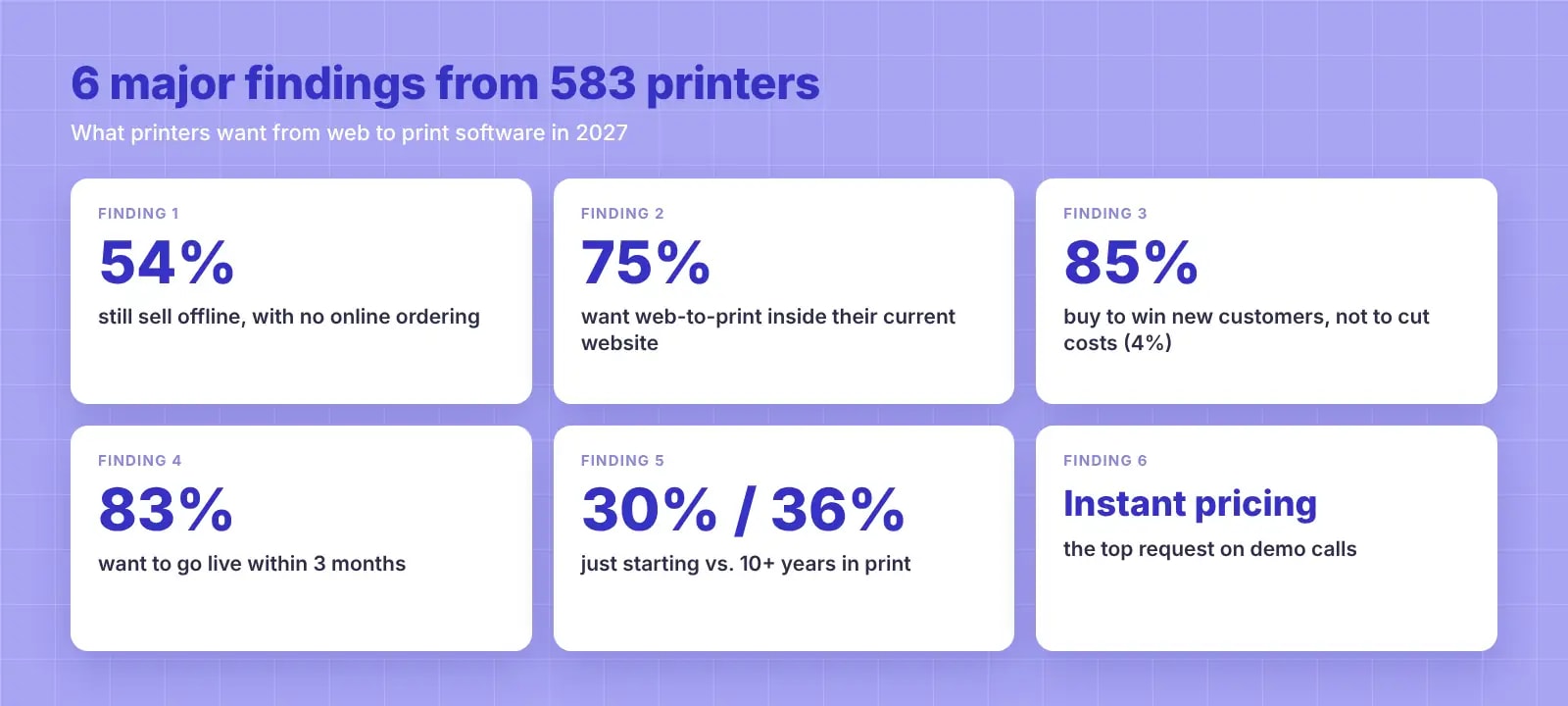
Key findings at a glance
Finding | Share of printers |
|---|---|
Still sell mainly offline | 54% |
Want web-to-print added to their existing website | 75% |
Main goal is to win new customers | 85% |
Want to start immediately | 60% |
Want to start within 3 months (incl. immediately) | 83% |
Just starting a print business | 30% |
In print for 10+ years | 36% |
The picture is a market in a hurry. Most printers are not shopping around for later. They want to grow, and they want to start now.
Finding 1: more than half of printers still sell offline
54% of printers told us they do business offline today. Only 45% already sell through a website.
Offline does not mean small or slow. On demo calls, offline printers often described busy shops with fast presses. What they lack is a way for customers to order without a phone call or an email. One commercial printer said every order arrives by phone or email and staff type each item in by hand.
What it means for you: if you still take orders by phone and email, you are not behind your peers yet, but the window is closing. Each manual quote is a chance for the customer to order somewhere faster.
Finding 2: three in four want web-to-print inside the website they already have
75% of printers want web to print software added to their current website. 24% want a complete solution that includes a new storefront.
Many already run a store on Shopify, WooCommerce, Magento or BigCommerce. They have products, customers and search rankings there, and they do not want to start again. What they are missing is the print-specific part: an online design tool, live pricing, artwork upload and print-ready files.
The 24% who want a full storefront are a different group: two in three of them sell offline today. For them, a complete web-to-print storefront is faster than piecing together a website and a separate tool.
What it means for you: decide which group you are in before you talk to vendors. If you already have a store that works, ask for a tool that plugs into it, not a rebuild.
Finding 3: printers buy for growth, not for cost savings
85% of printers said their main goal is to win new customers and grow. Every other goal came a distant second.
What printers want web-to-print to do | Share of printers |
|---|---|
Win new customers and expand the business | 85% |
Serve existing customers better | 7% |
Automate back-office processes | 7% |
Reduce internal costs | 4% |
Printers could pick more than one goal, so the shares add up to more than 100%.
The low score for automation is surprising, because automation came up on almost every demo call. Printers described quotes typed by hand, proofs sent back and forth by email, and staff tied up on small orders. They just don't call it automation. They call it growth: more orders without hiring more people.
What it means for you: judge any tool by how many more orders it lets your current team handle, not only by how many new visitors it brings.
Finding 4: most printers want to go live within 3 months
60% of printers want to start immediately, and another 23% within three months. Only 7% said six months, and just 9% said later or not decided yet.
By the time a printer starts looking at web to print software, the decision is close. Many have already lost an order to a competitor with an online store. That urgency has a downside: printers who want to launch fast often underestimate setup, from product templates and pricing rules to fonts and print-file testing.
What it means for you: plan the setup work before you sign. Knowing who builds your templates and pricing, and how long it takes, is what separates a three-month launch from a six-month one.
Finding 5: new print businesses and veterans want the same thing
The printers looking for web-to-print are split almost evenly between new and established businesses.
Years in the print business | Share of printers |
|---|---|
10+ years | 36% |
6–10 years | 11% |
1–5 years | 23% |
Just starting | 30% |
Veterans often run older websites, existing order systems and long-built pricing sheets they need to carry over. New businesses have none of that, but usually have a smaller budget and want a simple, low-risk start. Yet both want the same outcome: an online store that takes print orders without manual work.
What it means for you: the right setup depends on where you start. Established shops should ask about migration and integrations; new shops should ask about a lean launch they can grow from.
Finding 6: printers want customers to see the price instantly
On demo calls, one request came up more than any feature: let the customer see an accurate price straight away, without waiting for a quote.
Today, many printers quote by hand. A customer emails or fills in a contact form, staff work out the price, and the quote goes back hours or days later. By then, the customer has often ordered somewhere else. Printers told us exactly what their prices depend on:
Paper stock and size
Bleed and finishing, such as lamination, drilling or binding
One or two sides, colour or black and white
Number of ink colours for screen printing
Quantity breaks and tier pricing
Custom sizes, such as labels or banners
What it means for you: test the pricing engine with your most complicated product. If it can price that one correctly and instantly, it can handle the rest.
Instant prices, even for complex print jobs
DesignNBuy's print estimating software lets you set pricing rules around the things that drive your costs, such as stock, size, finishing and quantity, so customers see a price while they configure their order instead of waiting for an email quote.
What printers told us on calls
The survey shows what printers want. Our demo calls show why. Beyond pricing, four themes came up again and again.
Orders that flow straight to production. A common first question was what happens after checkout. Printers want orders to reach their ERP or print order management system and print a job ticket for the press team.
Print-ready files, every time. Bad customer artwork means proofs, reprints and delays. Printers want preflight checks that catch problems before files reach the press.
Price that fits the business. Small shops told us cost was their biggest worry. Many asked for a simple starting option or monthly payments instead of a large upfront fee.
Control over their own store. Printers who had switched tools before said they want to own their website, products and data, and not be locked to one provider.
B2B printers added one more: branded portals for corporate clients, where each client logs in to order from approved templates. That is exactly what a B2B web to print storefront is built for.
Planning to buy web to print software? Ask these 6 questions
Based on what 583 printers told us, here are six simple questions to ask before you choose a provider.
Will it work with my current website? If you already sell on Shopify, WooCommerce, Magento or BigCommerce, you should not have to build a new website.
I don't have a website yet. Can you build the full online store? If you sell offline today, a ready-made store will save you a lot of time.
Can it calculate prices for my products? Ask the provider to set up your most difficult product during the demo, not the easiest one.
What happens after a customer places an order? Ask to see the final print file and how the order reaches your production team.
How long will it take to go live? Ask who will set up your products and prices, and how many weeks it will take.
What is the total cost? Ask for the setup fee, the monthly or yearly fee, and what support is included, for both the first and second year.
If you are also deciding which storefront features matter most, our web-to-print storefront guide for 2027 is a good next read.
About the data
The figures come from 583 print businesses that filled in a DesignNBuy enquiry form (demo, free trial, quote or contact) between 12 November 2025 and 12 November 2026. Shares are rounded, and a few respondents skipped some questions. These are printers actively looking at web-to-print, so the results describe buyers, not the whole print industry. Comments from sales calls are paraphrased, and no customer is named.
See what web-to-print could look like for your business
Frequently Asked Questions
Abhishek Agarwal
Co-founder | CMO, DesignNBuy
Abhishek Agarwal (Co-founder/CMO, DesignNBuy) has 15+ years of IT & web-to-print experience. He specializes in sales, marketing, and strategic business growth, delivering innovative solutions to global printers and mentoring teams.
All PostsRelated Posts
Print Buyer Behavior in 2027: 4 Printing Industry Trends Every Printer Should Plan For
Web-to-Print Storefront Guide 2027: Focus on the 20% That Matters