Challenges for Printers in Europe: 10 Roadblocks (And How Web to Print Solves Each One)
European printers face unique hurdles from multi-currency pricing and 24+ languages to cross-border tax compliance. This guide breaks down 10 key challenges and shows how web-to-print technology solves each one.
 Nidhi Agarwal
Blog article content
European printers face a unique set of challenges – from managing 28 currencies and 24 languages to navigating country-specific tax rules and payment preferences. Web to print technology solves most of these challenges by automating design, pricing, payments, and logistics across borders. In this guide, I’ll walk you through the 10 biggest challenges faced by European print businesses and show you exactly how web to print platforms help overcome each one.
If you run a print business in Europe or you’re planning to expand into one of its 50+ countries, you already know it’s not a single market.
It’s dozens of markets stitched together.
Different currencies, languages, tax structures and customer expectations.
And yet, the opportunity is massive. European eCommerce sales crossed €323 billion ($437.91 billion USD), and print businesses that crack this market can scale fast.
But here’s the kicker: most printers hit the same walls when they try to go online across Europe.
I’ve seen it firsthand – working with hundreds of print, packaging, and merchandise businesses across the continent. Our 2026 Web-to-Print Industry Report, based on insights from 3,800+ print businesses, found that growth consistently ranked above cost savings as a key driver behind web-to-print adoption.
In this guide, I’ll break down the 10 biggest challenges for printers in Europe face and show you how web to print technology solves each one.
Let’s get into it.
10 Challenges European Printers Face in 2026
1. Managing Multiple Currencies Across Europe
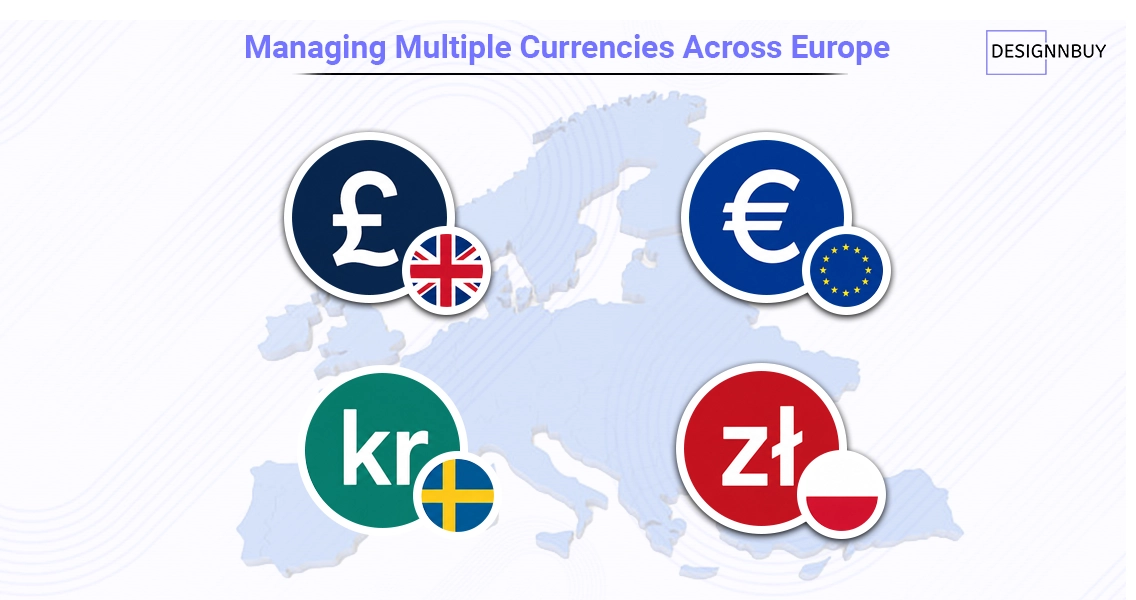 One of the most immediate challenges for printers in Europe is currency complexity — the continent uses 28 different currencies. The Euro covers 19 nations, but that still leaves a patchwork of local currencies — from the British Pound to the Swedish Krona, Polish Zloty, and Swiss Franc.
Here’s why this matters for printers:
Your web to print storefront needs to display the right currency based on where the customer is browsing from
Price estimation, calculations, and invoices all need to reflect the local currency
Manual currency management leads to errors, and errors lead to abandoned carts
A survey of 30,000 consumers across Canada, the UK, Australia, and Germany found that 92% of consumers prefer shopping from sites that display their local currency.
That’s not a preference – that’s a dealbreaker.
How web to print solves this:
A good web to print platform lets you configure flexible, customizable currency options for each storefront. No manual switching. No third-party plugins with security risks. Customers see prices in their currency, automatically.
The result? Higher trust, fewer drop-offs, and a smoother buying experience across borders.
2. Localizing Content Across 24+ Languages
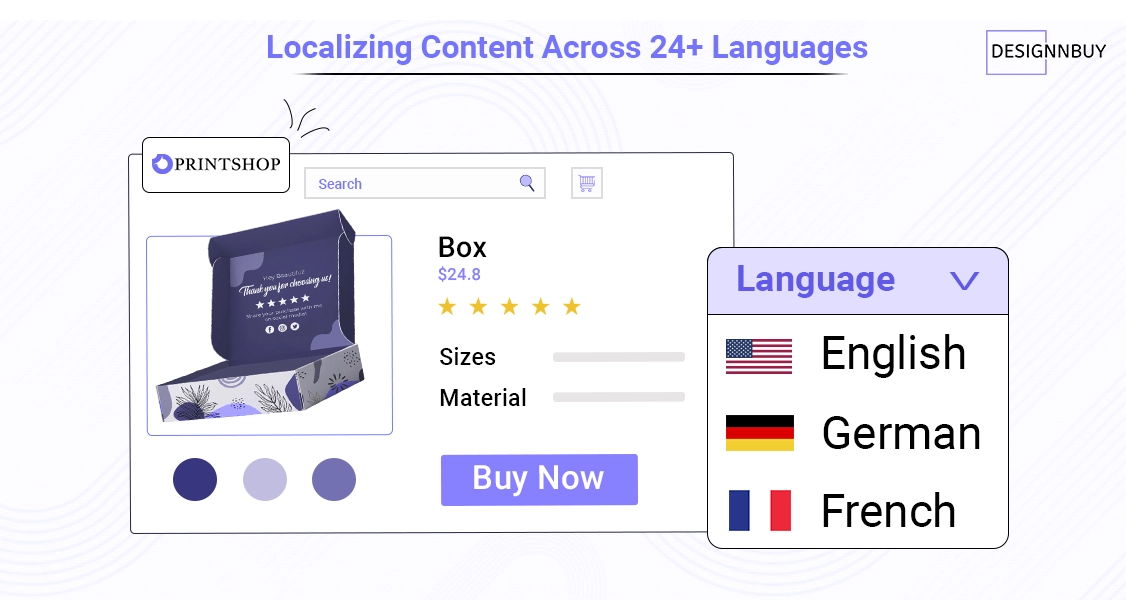
Europe has 24 official languages and that’s before you count regional dialects.
For printers, language isn’t just a UX issue. It’s a product issue.
Your customers are ordering printed products where the text IS the product — business cards, brochures, labels, and packaging. If the ordering interface isn’t in their language, confusion creeps in fast.
Now you might be wondering: “Do I really need to localize everything?”
Short answer: yes. At minimum, your product descriptions, pricing breakdowns, checkout flow, and support content should be available in the languages of the markets you serve.
How web to print solves this:
Configurable language settings let you localize the entire storefront — from product pages to the design editor to checkout. Your customers browse, design, and order in their native language without friction.
3. Navigating Country-Specific Payment Preferences
This one catches a lot of printers off guard — and it’s one of the most underestimated challenges for printers in Europe.
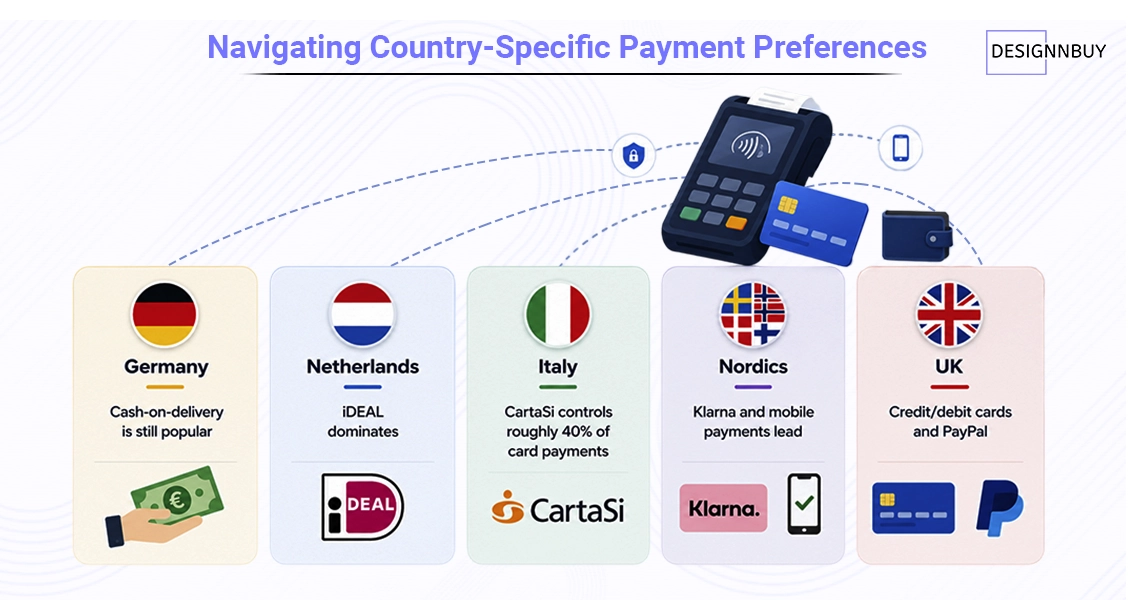
Payment preferences vary wildly across Europe:
Germany → cash-on-delivery is still popular
Netherlands → iDEAL dominates
Italy → CartaSi controls roughly 40% of card payments
Nordics → Klarna and mobile payments lead
UK → credit/debit cards and PayPal
Many payment gateway providers only cover a handful of countries. If you’re using a single gateway, you’re leaving revenue on the table in every market it doesn’t support.
How web to print solves this:
The best web to print platforms offer configurable payment gateway integrations. You plug in the right gateway for each market, and customers pay the way they prefer.
Simple. No workaround needed.
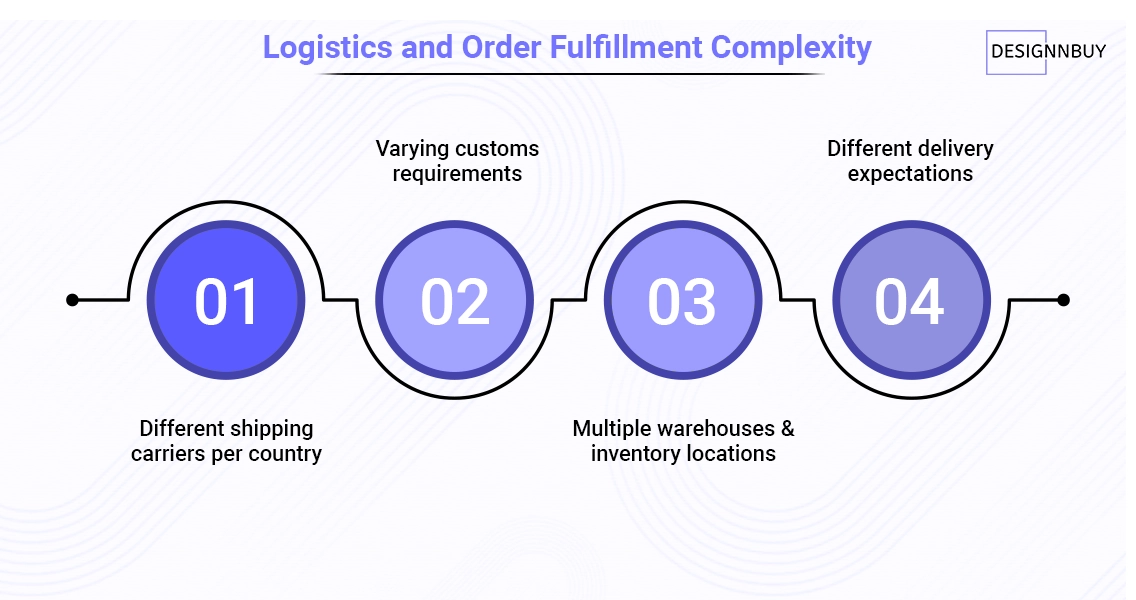
4. Logistics and Order Fulfillment Complexity
You’ve taken the order, processed the payment, produced the print job — now you need to deliver it.
And that’s where things get messy.
Coordinating logistics across European borders means dealing with:
Different shipping carriers per country
Varying customs requirements
Multiple warehouses and inventory locations
Different delivery expectations (next-day in the UK, longer timelines in Eastern Europe)
Let me break it down.
If your web to print system only supports one or two logistics integrations through rigid third-party extensions, you’ll hit a ceiling fast. You need a platform that lets you:
Partner with regional logistics providers who know the local landscape
Manage multiple brand stores and warehouses from one dashboard
Handle varying SKUs across different storefronts
How web to print solves this:
Platforms like DesignNBuywith customizable supplier and fulfillment partner integrations let you connect the right shipping partner for each market — without being locked into a single fulfillment provider.
The result? Reliable delivery, fewer missed shipments, and happier customers.
5. Design Templates That Work Across Languages
Here’s a challenge most printers don’t think about until they’re deep into it.
You’ve designed a beautiful template for a product label. It works perfectly in English. But now you need the same design in German, French, Italian, and Dutch.
Different languages have different text lengths. German words are notoriously long. French uses accents. Arabic reads right-to-left.
Manually creating language-specific versions of every template? That’s a full-time job, and an error-prone one.
How web to print solves this:
Instead of managing dozens of template variants, web to print platforms let you store one master template and give customers a “Design It Yourself” option inside their template builder.
Customers personalize the content in their own language, directly inside the editor. They handle the translation. You handle the print-ready output.
But that’s not even the best part.
This self-service approach doesn’t just save you time. It increases customer engagement. People who personalize their own designs feel more connected to the product, and they come back more often.
6. VAT and Tax Compliance Across Borders
Among the most compliance-heavy challenges for printers in Europe is VAT — the continent’s 50+ countries each have their own Value Added Tax structures. Rates differ. Rules differ. And getting it wrong isn’t just an inconvenience, it’s a compliance risk.
In the UK, for example, HMRC's Making Tax Digital for VAT rules require VAT-registered businesses to keep digital records and file returns through compatible software, one more jurisdiction-specific requirement to account for when selling across borders.
Here’s what makes it tricky for printers:
VAT rates change depending on the product type and destination country
B2B and B2C transactions are taxed differently
Manual calculations are slow, error-prone, and nearly impossible to verify at scale
Real-time pricing accuracy goes out the window when tax rules are hardcoded
How web to print solves this:
Advanced web to print platforms automate tax calculations for multiple jurisdictions. You configure the rules once (ideally with professional tax guidance), and the system handles it from there.
Every quote, every invoice, every checkout, accurate and compliant. Automatically.
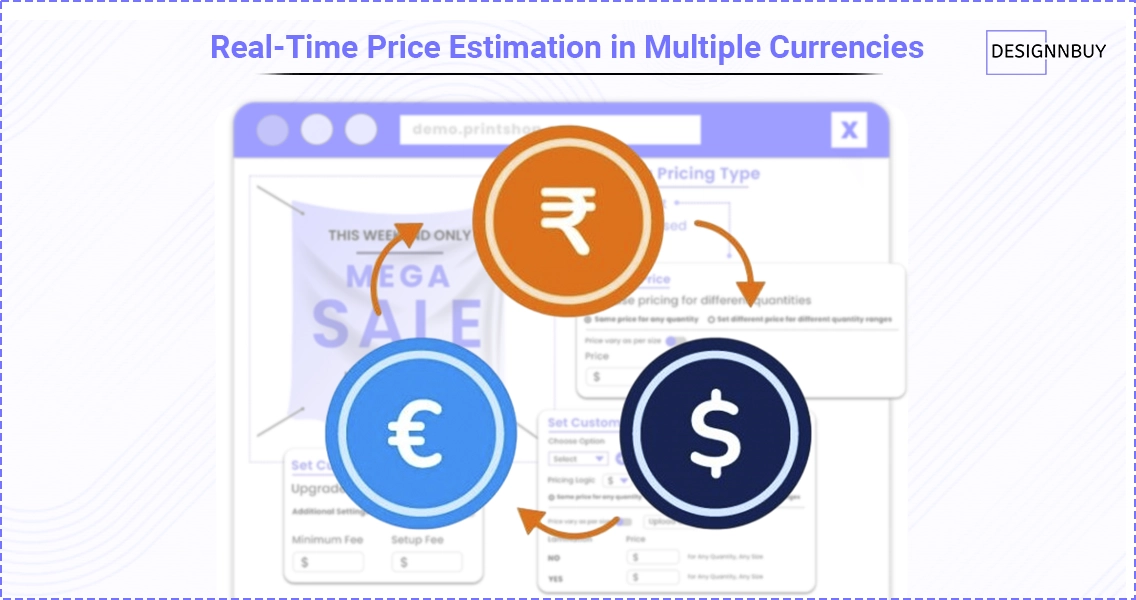
7. Real-Time Price Estimation in Multiple Currencies
This one connects directly to the currency and tax challenges above — but it deserves its own spotlight.
Your customers want instant pricing. They want to select a product, choose their options (size, material, quantity, finishing), and see the price — right now, in their currency.
If your pricing engine can’t do this in real time, you lose the sale. People don’t wait for manual quotes in 2026.
How web to print solves this:
Integrated pricing engines inside web to print platforms calculate estimates instantly, factoring in product customization options, currency, tax, and quantity. No third-party plugins. No security risks from external data handling.
Quick example: a customer in Poland selects a custom label, picks their material and quantity, and sees the price in PLN — instantly. That’s the experience that converts.
8. Keeping Up with Market Trends and Product Innovation
Keeping pace with shifting demand is one of the fastest-growing challenges for printers in Europe. They want unique, personalized products — and they want them fast.
Trends shift quickly:
Eco-friendly packaging is surging
Personalized merchandise is mainstream
Short-run, on-demand printing is replacing bulk orders
Premium presentation and “unboxing experiences” drive repeat purchases
If you can’t adapt your product catalog quickly, you fall behind.
How web-to-print solves this:
Web-to-print platforms let you launch new products virtually — without holding physical inventory first. You can:
Add new product types with custom options
Offer extensive personalization (colors, fonts, images, clip art, layouts)
Preview designs in real time before printing with 3D product configurator
Respond to trends without retooling your entire production line
We see this pattern across our clients: the printers who innovate fastest on their product catalog are the ones growing the most.
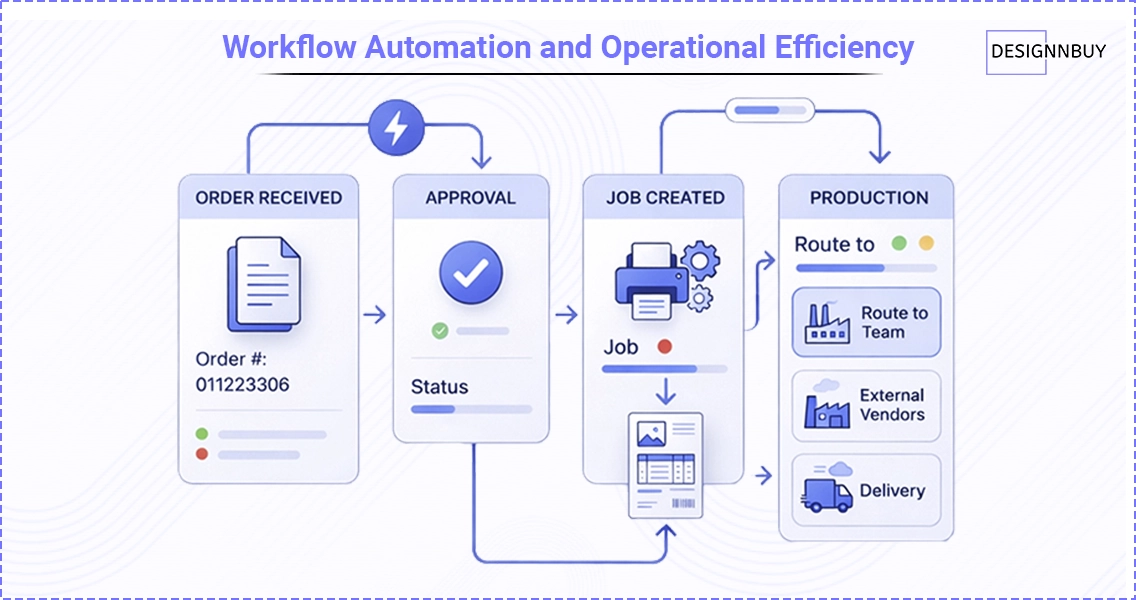
9. Workflow Automation and Operational Efficiency
Here’s a pattern I see over and over — one of the most operationally painful challenges for printers in Europe is the failure to automate as they scale:
They add more products, more markets, more customers — but they don’t automate their workflows. And suddenly, they’re drowning in manual tasks.
Order management. File checks. Preflight approvals for accuracy. Job tracking. Vendor coordination.
Every step that requires a human touch is a step that slows you down and introduces errors.
How web-to-print solves this:
This is where web-to-print really shines. A solid platform automates the entire workflow — from the moment a customer places an order to the moment it ships:
Design automation → customers upload or customize designs, and the system generates print-ready files automatically
Instant quotation → no manual pricing; the system calculates in real time with a quoting workflow software
Centralized order management → all orders, statuses, and customer data in one dashboard
One-click reordering → returning customers reorder in seconds
Production tracking → monitor jobs, machinery, and productivity from one place
The result? Faster turnaround, lower fulfillment costs, and the ability to scale without proportionally scaling your team.
At DesignNBuy, we’ve built our platform around this exact workflow, because we’ve seen what happens when printers try to scale manually. It doesn’t work past a certain point.
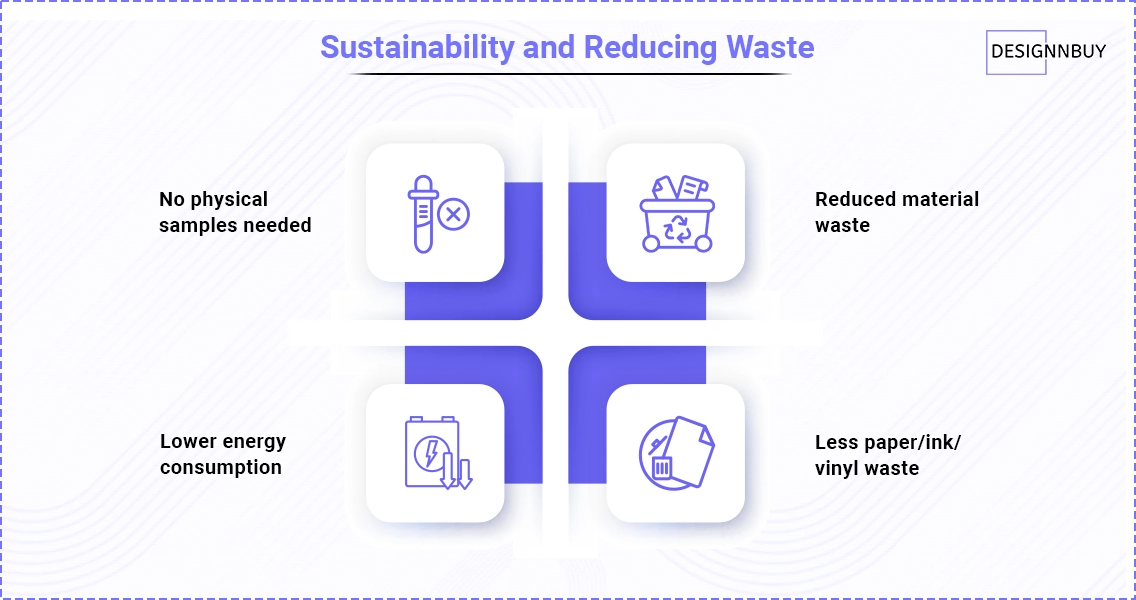
10. Sustainability and Reducing Waste
This one is becoming non-negotiable in Europe.
European consumers and regulators are pushing hard on sustainability. Printers who can demonstrate eco-friendly practices have a real competitive edge.
But here’s the thing, going sustainable isn’t just about using recycled paper. It’s about reducing waste across your entire operation.
How web-to-print helps:
No physical samples needed → customers preview designs digitally before ordering
Reduced material waste → accurate files mean fewer reprints
Lower energy consumption → streamlined digital workflows replace manual processes
Less paper/ink/vinyl waste → print only what’s ordered, nothing more
Web-to-print isn’t just a sales tool. It’s an operational tool that helps European printers meet sustainability expectations — without sacrificing speed or margins.
Want to Turn Sustainability Into a Business Advantage?
Eco-friendly printing isn’t just good for the planet — it builds trust, wins contracts, and drives repeat business. Learn how sustainable printing builds your reputation and revenue.
Bonus: Why 24/7 Mobile Accessibility Matters
One more thing worth mentioning.
Your European customers are spread across multiple time zones. They might be placing orders at midnight in Berlin or 6 AM in Lisbon.
A mobile-responsive web-to-print storefront means customers can browse, design, and order from any device, anytime, anywhere. No app downloads. No desktop-only limitations.
This sounds basic, but I’m surprised how many print businesses still don’t have a mobile-optimized ordering experience.
Already Have a Storefront? Now Get It in Front of Buyers.
Launching is step one. Driving traffic and converting visitors is step two. Get proven strategies to market your web-to-print store effectively.
Read: How to Promote Your Web-to-Print eCommerce Store →
How to Choose the Right Web-to-Print Platform for Europe
Not all web-to-print solutions are built to handle the challenges for printers in Europe. Here’s what to look for:
Feature | Why It Matters |
|---|---|
Multi-currency support | Customers see prices in their local currency |
Multi-language storefronts | Full localization – not just translated buttons |
Configurable payment gateways | Match each market’s preferred payment method |
Flexible logistics integrations | Connect regional carriers without lock-in |
Automated tax/VAT calculations | Stay compliant across 50+ jurisdictions |
Real-time pricing engine | Instant quotes in any currency |
Design editor with self-service tools | Customers personalize without needing your team |
Centralized order management | One dashboard for all markets |
Mobile-responsive storefronts | Orders from any device, any time zone |
At DesignNBuy, we’ve built our web-to-print platform specifically for businesses operating across complex, multi-market environments like Europe. From multi-currency storefronts to automated workflows and flexible integrations, it’s designed to remove the exact friction points I’ve covered in this guide.
The fastest way to evaluate a platform is to see it live. Check out upcoming print industry events where you can meet vendors, compare solutions, and ask the hard questions.
Browse: Top Printing Trade Shows in Europe, UK, USA & Canada →
Wrapping Up
Expanding a print business across Europe is hard. The challenges for printers in Europe stem from the same diversity that makes the continent exciting – it also makes operations complex.
But the printers who invest in the right technology, specifically, a web-to-print platform built for multi-market complexity, are the ones scaling fastest.
Here’s a fast recap of the 10 challenges we covered:
Multiple currencies
Multiple languages
Country-specific payment preferences
Logistics and fulfillment complexity
Multi-language design templates
VAT and tax compliance
Real-time pricing in local currencies
Market trends and product innovation
Workflow automation
Sustainability and waste reduction
The common thread? Web-to-print solves all of them.
If you’re a European printer or expanding into Europe and you’re still running things manually, here’s a step-by-step guide on how to launch your web-to-print storefront and start selling across borders.
Frequently Asked Questions
Ready to Sell Print Across Europe Without the Operational Headaches?
Nidhi Agarwal
Co-founder/CEO, DesignNBuy
Nidhi Agarwal (Co-founder/CEO, DesignNBuy) is a tech entrepreneur specializing in print industry innovation. Known for her strategic problem-solving, she defines the company’s roadmap and is a leading voice in web-to-print technology.
All Posts

Trusted by 2000+ Print Businesses
Ready to See It in Action?
Explore our print shop platform at your convenience. Request a demo URL to experience the storefront, design tool, pricing, and much more.