15 Web to Print Software Statistics Your Print Business Should Know in 2026
 Tavishi
Blog article content
If you’re trying to understand where the print industry is heading, web to print software statistics are the fastest way to get there. They show how fast the market is growing, where the money is going, and what print businesses need to do to stay competitive.
Quick Answer: In 2026, the global web-to-print market is worth approximately $36.3 billion, with the web to print software segment alone valued at roughly $2.05 billion and growing at a CAGR between 8% and 9.4%. The print on demand market is expanding even faster, at around 26% CAGR. North America leads in software revenue, while Asia-Pacific is the fastest-growing region.
Web to print software is the platform layer behind online design, ordering, and production for print and packaging businesses. It lets customers personalize products through a browser, then routes the order straight into production. The web to print software statistics below explain why more print businesses are adopting this model, and what it means for yours.
We pulled these numbers from independent market research firms, including IMARC Group, Persistence Market Research, Grand View Research, and Precedence Research. Where reports disagree slightly, we’ve noted both figures so you get the full picture.
Web to Print Software Statistics: Market Size and Growth in 2026
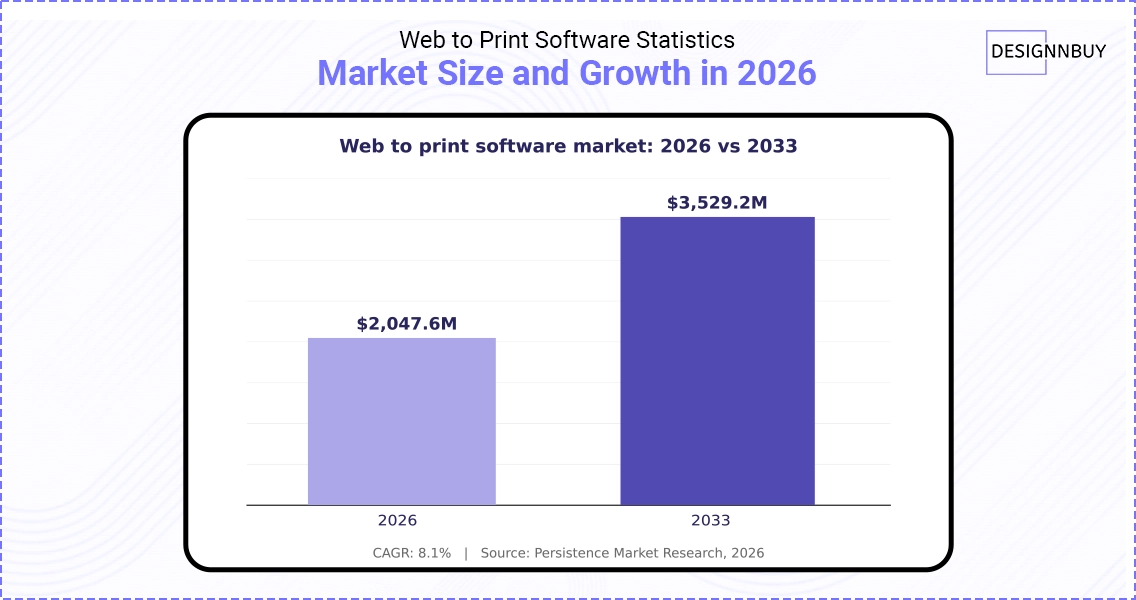 These web to print software statistics answer the most common question first: how big is this market, and how fast is it growing?
1. The global web-to-print market reached $36.3 billion in 2025 and is projected to hit $52.9 billion by 2034, at a CAGR of 4.15%.
This figure covers the full web-to-print ecosystem, including software, services, and fulfillment. Europe currently holds the largest regional share, at over 34.7%. (Source: IMARC Group, 2025)
2. The web to print software market specifically is projected to grow from $2,047.6 million in 2026 to $3,529.2 million by 2033, at a CAGR of 8.1%.
This is the narrower, software-only figure. Software and platform solutions account for more than 72% of this market, valued at over $1,474.2 million in 2026. (Source: Persistence Market Research, 2026)
3. Another estimate places the web to print software market at $1.85 billion in 2024, growing to $3.75 billion by 2033 at a CAGR of 9.4%.
Cloud-based deployment leads this growth, driven by AI-powered personalization tools and demand from B2B print services and on-demand packaging. (Source: Verified Market Reports, 2026)
Different reports use different scopes, so the numbers vary. But every one of them points the same direction: steady, multi-year growth in software-driven print platforms. If you’re still running orders through email and spreadsheets, this is the gap you’re competing against.
Web to Print Software Market Share by Region
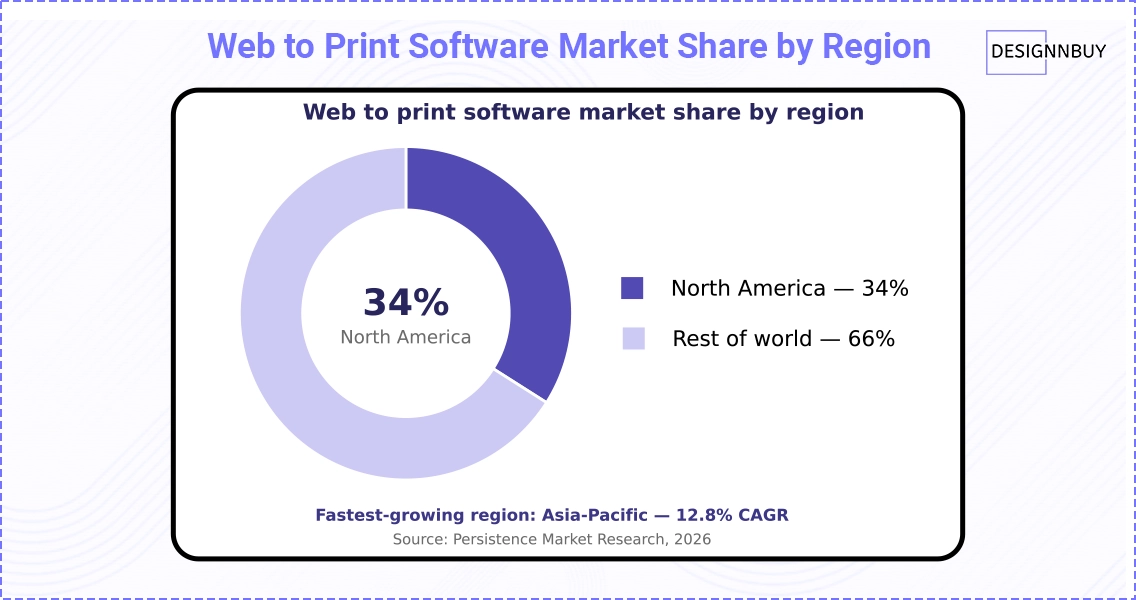
Regional data in web to print software statistics shows where demand is concentrated, and where it’s growing fastest.
4. North America leads the web to print software market with over 34% share, valued at $696.2 million in 2026.
This lead comes from mature SaaS adoption, strong e-commerce infrastructure, and advanced print workflow automation already in place across the region. (Source: Persistence Market Research, 2026)
5. Asia-Pacific is the fastest-growing region for web to print software, with a projected CAGR of 12.8%.
Rapid digitalization, growing SME adoption, and expanding print-on-demand activity across China and India are driving this growth. Commercial printing remains the largest industry segment overall, holding more than 40% share, while retail is the fastest-growing vertical at 11.6% CAGR. (Source: Persistence Market Research, 2026)
If you’re operating in North America, you’re in the largest market, but also the most competitive one. If you’re in Asia-Pacific, the growth curve is steeper, and getting your platform right now puts you ahead of slower-moving competitors.
Web to Print Software Adoption and Technology Trends
This part of the web to print software statistics picture covers what print businesses are actually using day-to-day, not just market projections.
6. 70% of EU businesses had attained basic digital intensity by 2022, with 98% of large businesses and 69% of SMEs adopting digital solutions.
Europe’s high digital readiness is a direct enabler of web to print software adoption, particularly as the region already holds the largest share of the global W2P market. (Source: European Commission, cited via IMARC Group, 2025)
7. The printing software market’s cloud-based segment is growing at a 20% CAGR through 2031, while software overall holds more than three-fifths (60%+) of total market share.
Cloud is now the fastest-growing deployment model in printing software because it cuts IT overhead and server management costs for businesses running multi-location operations. (Source: Allied Market Research, 2024)
If your platform doesn’t run in the cloud, doesn’t work well on mobile, and doesn’t offer AI design assistance, you’re behind the baseline, not ahead of a trend.
Print on Demand (POD) Market Statistics
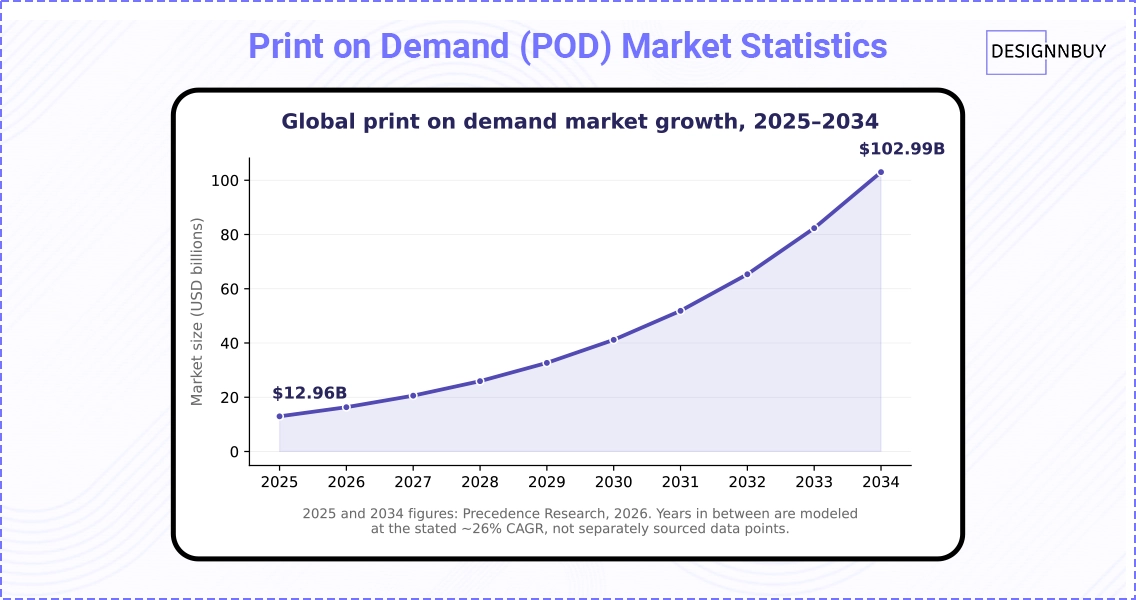
Print on demand is the fastest-growing part of the web to print ecosystem, and these web to print software statistics show why it matters even if you’re not a POD-only business.
8. The global print on demand market was valued at $12.96 billion in 2025 and is projected to reach $102.99 billion by 2034, growing at roughly 26% CAGR.
At this pace, the market roughly doubles every three years. (Source: Precedence Research, 2026)
9. The US print on demand market was worth $2.53 billion in 2024 and is expected to reach $26.95 billion by 2034, a tenfold increase.
Creator economy growth and integrations with platforms like Shopify and Etsy are major drivers behind this jump. (Source: Precedence Research, 2025)
10. Software accounts for nearly 69.6% of POD platform revenue, and apparel holds the largest product share at 39.5%.
The value sits firmly in the platform layer, not just the physical product. Home décor is the fastest-growing category within POD. (Source: Grand View Research, 2025)
11. Asia-Pacific is the fastest-growing POD region, with CAGR estimates ranging from 24.8% to 28%.
Manufacturing infrastructure and digitizing supply chains in China and India are driving this regional surge. (Source: Precedence Research, 2025)
Even if you don’t sell directly to consumers, POD growth is shaping buyer expectations across all of print. Customers who shop on POD platforms expect the same speed and personalization when ordering from you.
Personalization and Product Customization Statistics
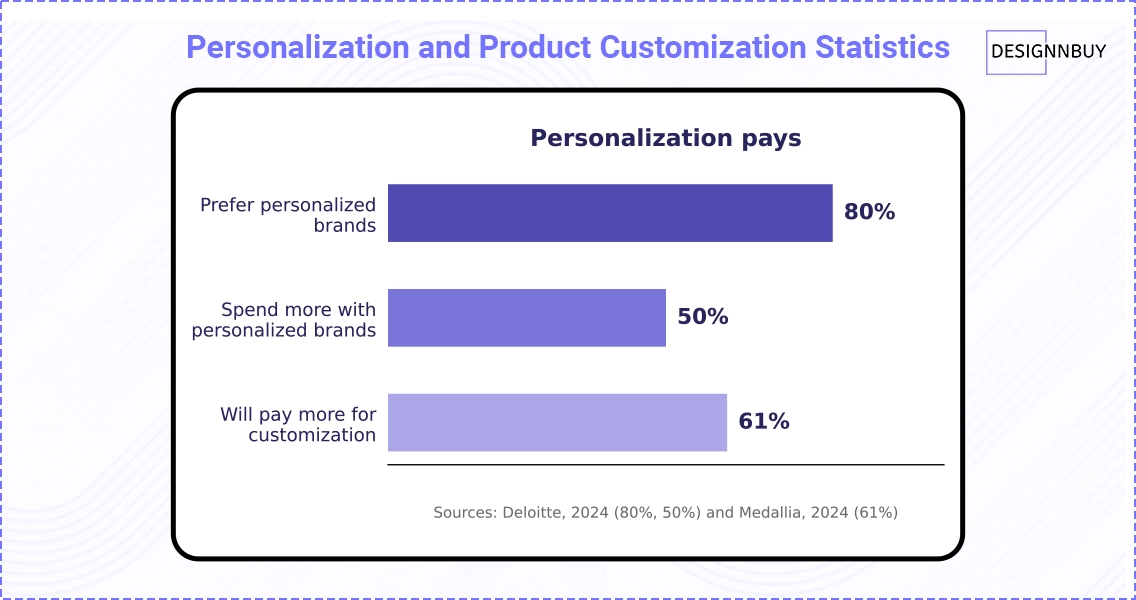
Customer behavior data in these web to print software statistics explains the demand side of the equation: why customers want personalized products, and what happens when you don’t offer them.
12. The personalized packaging market is valued at $40.30 billion in 2026 and is projected to reach $58.55 billion by 2033, growing at 5.5% CAGR.
Food and beverage brands lead this trend, expected to hold 41.8% share by 2026, as personalized packaging becomes a tool for emotional brand connection, not just product protection. (Source: Coherent Market Insights, 2026)
13. 80% of consumers prefer brands that offer personalized experiences, and these consumers report spending 50% more with those brands.
This isn’t a soft preference. It’s a direct revenue signal: product personalization correlates with measurably higher spend. (Source: Deloitte, 2024)
14. 61% of consumers say they’re willing to spend more with companies that offer a customized experience.
Customization isn’t just a retention tool. It’s a willingness-to-pay lever that print businesses can act on directly through personalized product offerings. (Source: Medallia, 2024)
A storefront without personalization options isn’t just missing a feature. It’s losing a majority-preference buyer to a competitor who has one.
AI and Automation Statistics in Web to Print Software
15. 85% of print service providers say AI is now critical to staying competitive, and over 70% list productivity as their top business priority for 2026.
More than half are already planning investments in automation for bindery and finishing processes. The conversation around AI in print has moved from curiosity to active implementation. (Source: Printing United Alliance, 2025–2026)
When 85% of your peers say AI is critical and most are already piloting it in estimating, prepress, or workflow automation, “wait and see” is no longer a neutral position. It’s falling behind in slow motion.
Web to Print Software Statistics: Key Takeaways for 2026
These web to print software statistics tell a consistent story. The software layer is growing faster than the broader print market. Cloud, mobile, and AI have moved from optional to expected. Personalization demand is now mainstream, not a niche preference. And the businesses already investing in automation are pulling ahead of the ones still deciding.
None of this means the window has closed. It means the cost of waiting is going up every quarter. The print businesses that act on these web to print software statistics now, by upgrading their storefront, automating order processing, and building in personalization, are the ones setting the pace for 2026 and beyond.
Conclusion
The print industry is not slowing down. It is shifting toward software, automation, and personalization. The businesses that understand this shift and act on it early will define what print looks like in the next decade. The ones that don’t will spend that decade catching up. The data has already made its case.
Frequently Asked Questions
Still Running Print Orders the Old Way While Your Competitors Automate?
Tavishi
Content Writer at @DesignNBuy
Tavishi is a content writer at @DesignNBuy, focused on the web to print industry. She creates well researched, easy to read content that helps print businesses understand digital solutions, product customization, and modern printing workflows.
All PostsRelated Posts
Challenges for Printers in Europe: 10 Roadblocks (And How Web to Print Solves Each One)
7 Ways Using a Web to Print Software Will Actually Save You Money in 2026
The Complete Web to Print Implementation Guide: From Planning to Client Onboarding
Trusted by 2000+ Print Businesses
Ready to See It in Action?
Explore our print shop platform at your convenience. Request a demo URL to experience the storefront, design tool, pricing, and much more.