The Complete Mass Customization Guide: Types, Benefits, Challenges & Future Trends
 Abhishek Agarwal
Blog article content
Mass customization is how modern businesses deliver personalized products at the speed and cost of mass production, and it’s quickly becoming the baseline expectation, not a differentiator.
If you’re a print business, manufacturer, or product brand still running a one-size-fits-all model, you’re already losing customers to businesses that let people design their own. This guide breaks down exactly what mass customization is, the four types, how it works in practice, the benefits, the challenges, and where it’s heading, so you can decide how to implement it in your own business.
What Is Mass Customization?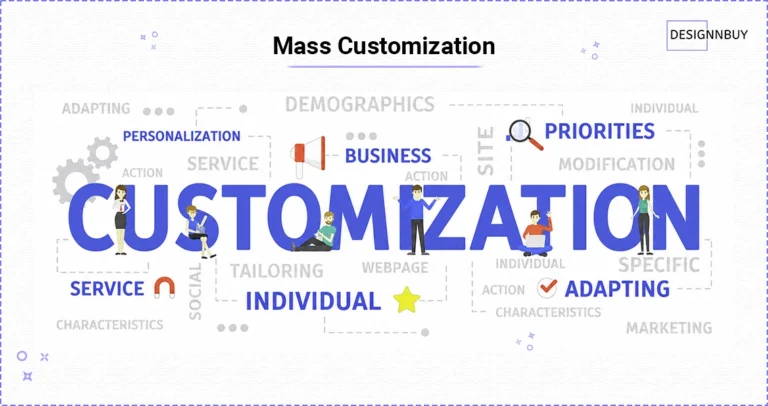
Mass customization is a strategy that lets businesses offer personalized products at the scale and cost of mass production.
Instead of making the same product for everyone, you give customers meaningful choices – colors, sizes, text, materials, designs, and your production system handles those variations efficiently behind the scenes.
The result? Every customer feels that the product was made specifically for them. But your operations don’t grind to a halt.
A simple way to think about it: when you design your own sneakers on Nike’s website, that’s mass customization. Nike isn’t hand-stitching a one-off pair. It’s using a smart, modular production system to handle your specific choices at scale, quickly and profitably.
And the demand is real. According to McKinsey, 71% of consumers expect companies to deliver personalized interactions, and 76% get frustrated when that doesn’t happen. Businesses that offer this see higher sales, fewer returns, and more loyal customers.
Mass Customization vs. Mass Production vs. Bespoke Manufacturing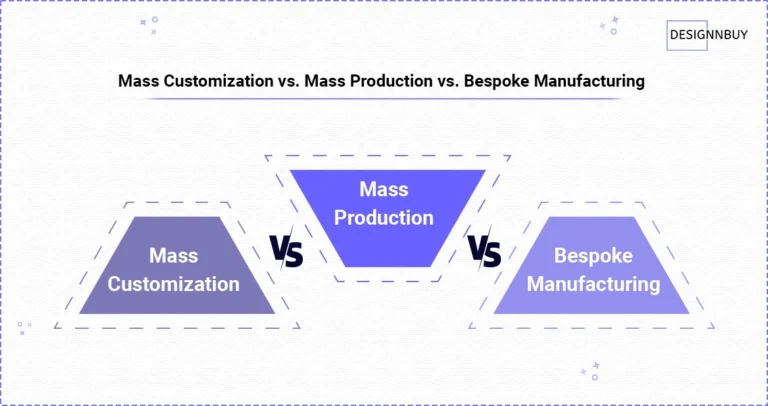
It helps to see where mass customization sits on the spectrum:
Mass Production – Same product, made in large volumes, at low cost. Efficient, but zero personalization.
Bespoke Manufacturing – A completely unique product built from scratch for each customer. Personal, but expensive, slow, and impossible to scale.
Mass Customization – The best of both. Customers get a product that feels personal. You keep your production running efficiently.
This balance is why mass customization has become the go-to model for modern product businesses.
The 4 Types of Mass Customization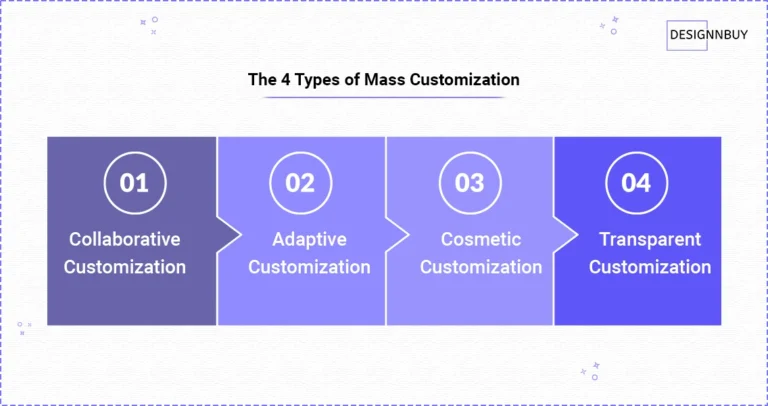
Mass customization doesn’t look the same in every business. There are four main approaches, each suited to different products and customer relationships.
1. Collaborative Customization
You work with customers to help them figure out exactly what they need, then build it. This works well for complex products where customers have a vision but need guidance to get there.
Example: A print business using DesignNBuy’s online design tool, DesignO helps a corporate client build branded stationery, collaborating on layout, colors, and specs until it’s exactly right.
2. Adaptive Customization
You offer a standard product that customers can adjust themselves, either before purchase or after.
Example: Fitbit sells the same base device to everyone, but each user can swap bands, change display settings, and personalize their goals. One product, infinite configurations.
3. Cosmetic Customization
The product is the same. What changes is how it looks or how it’s presented – names, colors, packaging, labels.
Example: A brand adding customer names to product packaging for a gifting campaign. The product inside is identical, but the personal touch creates real perceived value.
4. Transparent Customization
You personalize the product based on what you already know about the customer, without them having to do anything.
Example: Stitch Fix curates clothing selections based on a customer’s style profile and purchase history. The customer doesn’t “design” anything. They just receive something that feels made for them.
Looking for the right configurator to power your customization strategy? Here’s the top product configurator software options to compare.
Real-World Mass Customization Examples
Mass customization is working across almost every industry. Here’s how leading businesses are doing it:
Fashion & Footwear: Nike By You lets customers pick materials, colors, and add personal text to their shoes. It’s become a premium, higher-margin product line, and it builds the kind of brand loyalty that generic products can’t.
Consumer Electronics: Dell lets customers configure their laptops, choosing processor, RAM, storage, and display, before the product is even assembled. Dell builds to order, which means less unsold inventory and happier customers who got exactly what they asked for.
Food & Beverage: Subway lets every customer build their own sandwich from a fixed set of ingredients. Same kitchen, infinite combinations. Coca-Cola’s “Share a Coke” campaign, printing individual names on bottles, is a classic cosmetic customization example that drove double-digit sales growth.
Print & Packaging: This is where mass customization is arguably most mature. Print businesses using web-to-print platforms like DesignNBuy let customers upload artwork, edit templates, choose finishes, and place print-ready orders, all without anyone at the print shop touching a file manually. Variable Data Printing takes it even further, enabling each piece in a large print run to carry unique text, names, or images automatically.
Automotive: Porsche’s customization program lets buyers choose exterior color, interior materials, stitching, and performance upgrades. The result? Higher average selling prices and customers who almost never cancel, because they designed it themselves.
Want to see what personalization looks like in practice? Explore how product personalization benefits eCommerce print stores with real data and use cases.
Key Benefits of Mass Customization
Customers are happier: When people shape their own product, they’re more satisfied with the outcome. There’s less disappointment, fewer returns, and more positive reviews.
Less inventory waste: Build-to-order means you only make what’s already been sold. No piles of unsold stock, no markdowns, no storage costs.
Fewer cancellations: A customer who designed their own product is emotionally invested before it even ships. They almost never cancel.
You learn what customers actually want: Every design choice a customer makes is a data point. Over time, you build a clear picture of what’s trending, what gets ignored, and what drives repeat purchases, without needing a research study.
You stand out from competitors: In markets where products look and cost the same, mass customization is a real differentiator. It’s also hard to copy quickly, which makes it a durable competitive advantage.
Customers come back: Personalization builds emotional connection. Customers who feel a brand “gets” them, or better yet, lets them participate in creation, return more often and refer more readily.
The right configurator features are what make mass customization operationally viable, not just a nice idea. Here’s a breakdown of the key 3D product configurator features that support high-volume custom print production.
Challenges of Mass Customization (And How to Handle Them)
Mass customization comes with real operational challenges. Here’s what to watch for- and how to solve each one.
1. Managing thousands of product variations– When every customer order is slightly different, production gets complex fast. Without the right systems, errors multiply.
Fix: Design your products in modular components that vary independently. And use print workflow automation to handle variation, not people manually tracking each order.
2. Upfront technology investment– Setting up a 3D product configurator, connecting it to your production workflow, and building the underlying product architecture takes time and money.
Fix: Platforms like DesignNBuy cut this dramatically. Instead of building from scratch, you get a ready-to-deploy system that connects your storefront to production from day one.
3. Customer expectations vs. production reality– When someone co-designs a product, they have a very specific expectation. If what arrives looks different from what they saw on screen, satisfaction drops fast.
Fix: Use accurate 3D packaging previews and print-preview tools. DesignNBuy’s preflight software automatically check every file before it enters production, so what the customer sees is what gets made.
4. Supply chain complexity– More product variations can mean more raw material types and more supplier coordination. Getting this wrong leads to stockouts or excess material.
Fix: Use the demand data from your customization platform to forecast better. Your configurator data tells you exactly which combinations are popular before you buy materials.
5. Data errors between design and production– Manually re-entering customer design specs into production systems is where mistakes happen. Every handoff is a risk.
Fix: End-to-end automation that takes a customer’s design directly to a production-ready file, with no manual steps in between. This is exactly what DesignNBuy’s workflow automation handles.
The Technology Behind Mass Customization And How DesignNBuy Delivers It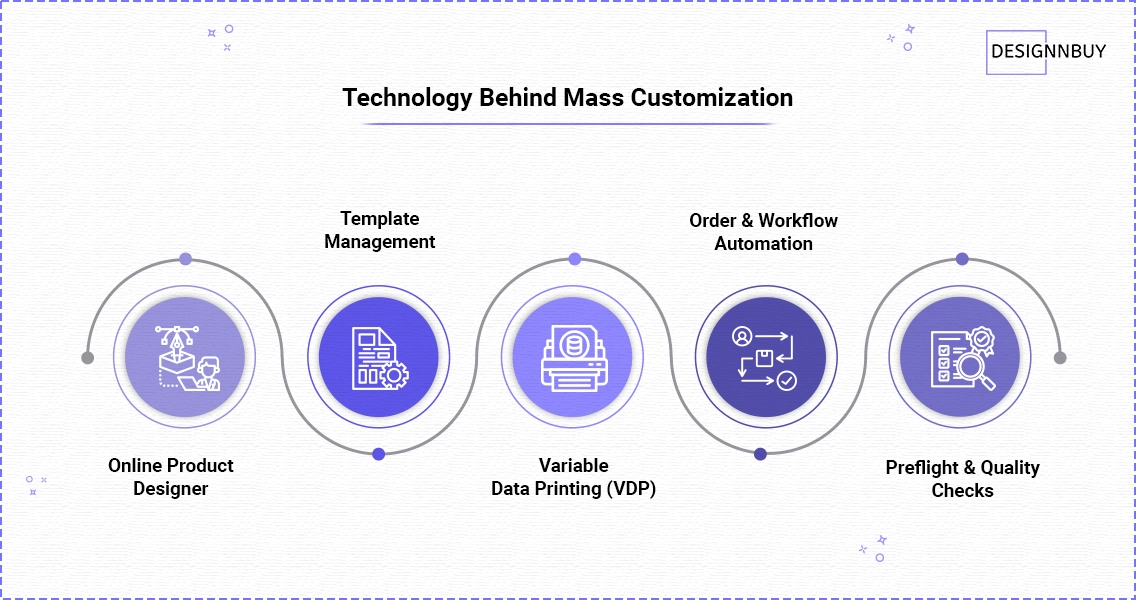
To run mass customization smoothly, a few core tools need to work together. Here’s what each one does — and how DesignNBuy handles it out of the box:
Online Design Editor: The front-end tool your customers use to personalize products directly on your storefront. It shows real-time visual previews, updates pricing dynamically, and is intuitive enough that customers don’t abandon halfway through. No emails, no phone calls, no manual spec collection.
3D Product Configurator: Customers see a photorealistic preview of their customized product before they order. What they see on screen is exactly what gets made, eliminating the gap between expectation and reality.
Template Builder: Pre-built, brand-safe templates that customers can edit within guardrails. They get creative freedom. You get print-safe, on-brand output, every time.
Variable Data Printing (VDP): For high-volume runs where every piece needs unique content, names, codes, addresses, images, VDP automates the whole thing. Thousands of personalized pieces, zero manual file prep per unit.
Preflight & Quality Checks: Every file is automatically checked for resolution, bleed, color mode, and other print specs before it touches a press. Errors get caught early, not after 500 prints.
Order, Job Management & Workflow Automation: Connects the customer’s finished design directly to production. Tracks job status, handles approvals, routes files to the right machine, and ties design, approval, production, and fulfillment into one automated flow, with no manual data re-entry and no lost jobs.
DesignNBuy works with WooCommerce, Shopify, Magento, BigCommerce, and more, so it fits into your existing setup without disruption.
When these pieces connect properly, mass customization stops being an operational headache and starts being your competitive edge.
Before your customer places an order, they need to see exactly what they’re getting. Learn why print businesses need a 3D product configurator to reduce order errors and increase conversions.
How to Implement Mass Customization in Your Business
Step 1 – Break your product into modules. Identify which elements can vary independently: size, color, material, finish, text, imagery. The more modular your product, the easier it is to offer combinations without complicating production.
Step 2 – Decide what to customize and what not to. Not every element needs to be customizable. Focus on the choices that matter to customers and keep production manageable. The best mass customization offerings are curated, not unlimited.
Step 3 – Choose the right platform. Your product configurator is your storefront for customization. It needs to be easy for customers to use and powerful enough to generate production-ready output automatically.
Step 4 – Automate the handoff from order to production. The biggest risk in mass customization is the gap between what the customer designed and what gets made. Automated file generation and workflow tools close that gap entirely.
Step 5 – Use the data. Track which options get chosen, where customers drop off in the configurator, and which combinations drive the best reviews. This data shapes smarter product decisions and better marketing – continuously.
Choosing the wrong platform is the most common implementation mistake. Compare the best product personalization software for scaling a print business before you decide.
The Future of Mass Customization
Mass customization is already reshaping how businesses operate, but what’s coming next is bigger. Technology is moving fast, and the businesses that understand where this is heading will be the ones best positioned to lead.
AI-assisted design– AI is starting to suggest designs, predict preferences, and generate custom artwork automatically. Soon, customers will start with a smart, personalized suggestion rather than a blank canvas.
3D printing unlocking new possibilities– Products that previously required expensive tooling to customize can now be varied freely. Additive manufacturing is removing physical constraints on what can be personalized.
Sustainable by design– Build-to-order means you only make what’s sold, which is inherently less wasteful. As sustainability becomes a bigger purchase driver, mass customization’s environmental advantage becomes a marketing asset too.
Hyper-personalization at every touchpoint– The direction of travel is clear: every product, every piece of packaging, every printed insert – uniquely personalized for the customer receiving it. Variable Data Printing is already making this real for print businesses today.
Mass customization going deeper into B2B– Corporate branded merchandise, regional packaging variants, campaign-specific print materials, B2B buyers increasingly expect the same personalization that B2C customers have come to expect.
Wrapping Up
Mass customization isn’t a trend. It’s the direction the entire product economy is moving. Customers want products that feel personal. Businesses that can deliver that, efficiently and at scale, have a genuine, durable advantage.
The good news? You don’t need to be Nike or Dell to make it work. With the right platform, the right product architecture, and the right automation in place, mass customization is achievable for businesses of every size.
Frequently Asked Questions
Ready to Offer Mass Customization Without the Operational Chaos?
Abhishek Agarwal
Co-founder/CMO, DesignNBuy
Abhishek Agarwal (Co-founder/CMO, DesignNBuy) has 15+ years of IT & web-to-print experience. He specializes in sales, marketing, and strategic business growth, delivering innovative solutions to global printers and mentoring teams.
All PostsRelated Posts

Trusted by 2000+ Print Businesses
Ready to See It in Action?
Explore our print shop platform at your convenience. Request a demo URL to experience the storefront, design tool, pricing, and much more.